October 7, 2026
Building a Sustainable Affiliate SEO Strategy for Passive Income
By @egfb01dbqy
Why Affiliate SEO Still Works for the Right People
If you have spent any time in the world of affiliate marketing, you have likely heard someone say that search engine optimization is dead or that ranking a niche site takes years. I have heard those claims too, and I understand why. The landscape has changed. Google updates like RankBrain have made the algorithm smarter, and the days of throwing thin content at a domain name and watching money roll in are long gone. But affiliate SEO is far from dead. What has died is the lazy approach.
The truth is that building a sustainable stream of passive income through affiliate websites still works. It just requires a different kind of work now. You need to think like a publisher, not a spammer. You need to treat your content management system as a tool for building authority, not a dumping ground for rewritten product descriptions. And you need to accept that keyword research, on-page SEO, and backlinks are not optional extras. They are the foundation of any serious effort.
I have been doing this long enough to watch people give up after six months because they expected quick results. The ones who stick around and adapt are the ones who eventually build something that pays the bills month after month. That is what this article is about: the practical, human approach to affiliate SEO that works when you treat it as a long-term craft rather than a hack.
Start With the Right Niche and the Right Mindset
Every good affiliate site begins with a niche that has real search demand and genuine user intent. You do not need a huge market. In fact, smaller niches often convert better because the audience is more focused. Tools like Semrush and Ahrefs can help you identify long-tail keywords that indicate buying intent rather than just curiosity. For example, a search for "best espresso machine under 500" tells you the user is ready to purchase. A search for "espresso machine history" does not.
When you pick a niche, think about whether you can write authoritatively about it or at least learn enough to create helpful content. You do not need to be a certified expert, but you do need to care enough to answer real questions. The best affiliate SEO comes from a place of genuine usefulness. If you are only chasing keywords with high commission rates, you will produce flat content that nobody wants to read or share.
Once you choose your niche, register a domain name that relates to the topic. It does not need to be an exact match keyword domain. A brandable name that suggests the focus of the site works fine. Then set up hosting with a reliable provider like WP Engine, install a content management system, and start building. Do not overthink the technical side at the beginning. A clean theme, fast loading times, and a simple structure are enough to get started.

Keyword Research That Goes Beyond Volume
Many beginners make the mistake of targeting only high-volume keywords. They compete with big authority sites and wonder why they get no traffic. A smarter approach is to focus on long-tail keywords that have lower competition and higher conversion potential. Tools like ChatGPT can help you brainstorm topic clusters, but you still need to verify search volume and difficulty with a dedicated tool like Semrush or Ahrefs.
For example, instead of targeting "best running shoes," which is dominated by major publications, you might target "best running shoes for flat feet with arch support." That keyword has fewer searches per month, but the people searching it are much more likely to click an affiliate link and buy. That is the kind of traffic that builds passive income over time.
Build a list of 20 to 30 long-tail keywords that cover different aspects of your niche. Then organize them into content pillars. Each pillar can become a guide or a comparison post. This structure helps Google understand your site's topical authority, and it makes your content management system easier to maintain.
Content That Serves the User First
Once you have your keywords, the real work begins. Write content that actually helps someone make a decision. Do not write for search engines. Write for the person who is sitting at their kitchen table, frustrated because they cannot find a reliable review of a product you cover. That person wants honest comparisons, real pros and cons, and specific recommendations.
When you write product reviews, include your own experience if you have used the product. If you have not, synthesize information from multiple trustworthy sources and clearly state that you are summarizing research. Honesty builds trust, and trust leads to clicks on your Amazon Associates or ShareASale links. It also reduces the risk of your content being flagged as low quality by Google's algorithms.
Use on-page SEO basics: include your target keyword in the title, in at least one heading, and naturally throughout the body. Write a meta description that summarizes the value of the page. Use internal links to connect related posts. These steps are simple, but they matter. I have seen sites double their traffic just by improving their internal linking structure and making sure every page has a clear purpose.
Building Backlinks Without the Headache
Backlinks remain a strong ranking signal, but you do not need to buy them or build a link farm. The most sustainable way to earn backlinks is to create content that other people want to reference. That could be an original statistic, a detailed guide, or a comparison table that saves someone hours of research. You can also reach out to other niche site owners and offer to write a guest post or collaborate on a resource.
If you are using AI website builders to speed up your workflow, be careful. Automated content often lacks the depth and nuance that earns natural backlinks. Use AI as a helper for research and outlines, but add your own analysis and voice. The sites that succeed with affiliate SEO are the ones where a human being made deliberate choices about what to include and how to present it.
You can also get backlinks by participating in forums and communities related to your niche. Leave thoughtful comments, answer questions, and occasionally link to a relevant post on your site when it genuinely adds value. This approach takes time, but it builds relationships and authority in a way that directory submissions never will.
Tracking What Matters
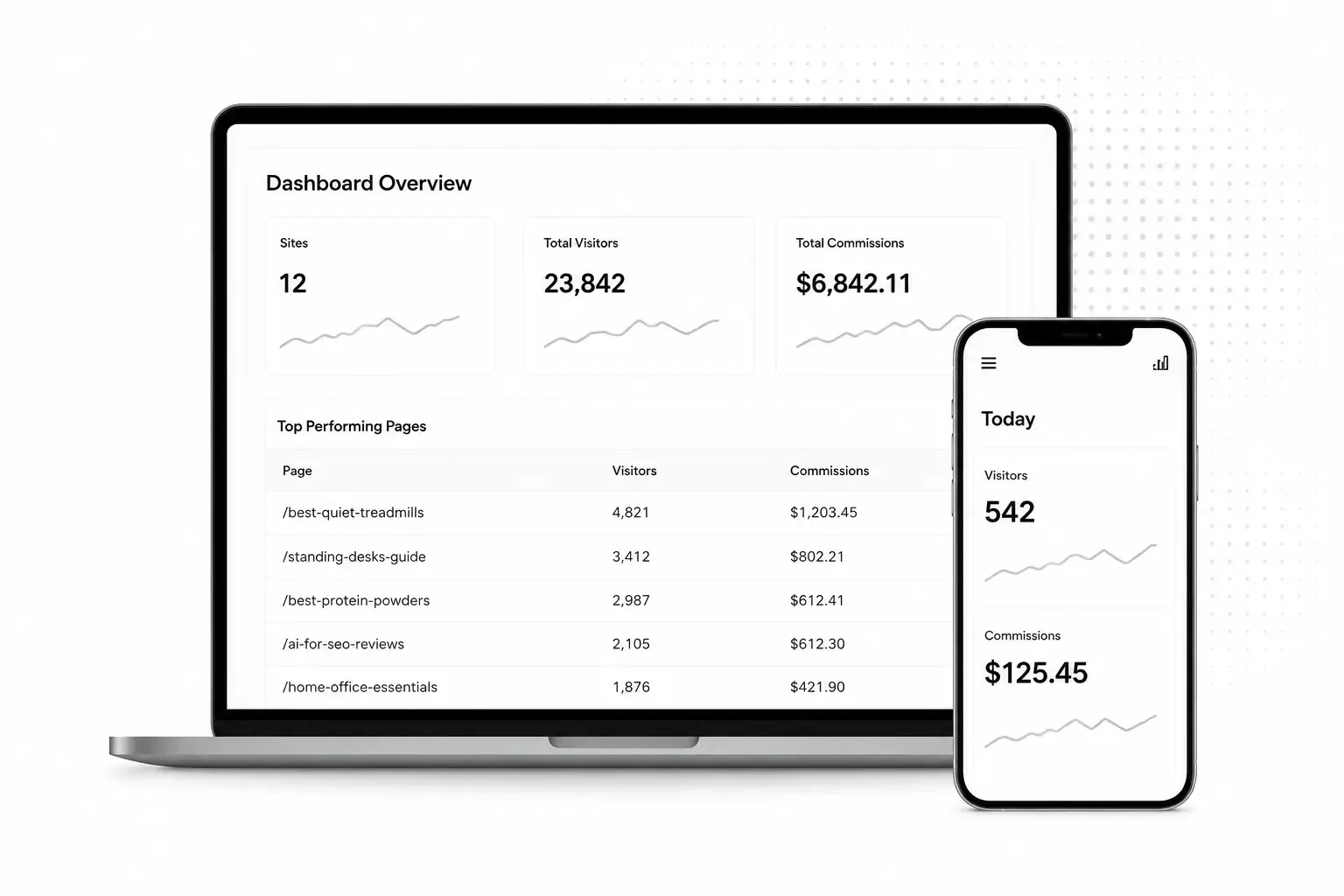
Set up Google Analytics on day one. You need to know which pages are getting traffic, where that traffic is coming from, and how users behave once they land on your site. Without data, you are guessing. With data, you can double down on what works and fix what does not.
Pay attention to bounce rate and time on page. If people are leaving quickly, your content may not match the search intent. If they stay and scroll, you are on the right track. Use the data to refine your keyword research and content strategy over time. The first version of a post is rarely the final version. Update old content, add new information, and improve internal links as your site grows.
Also track your affiliate commissions. Programs like Amazon Associates, ShareASale, and ClickBank provide dashboards where you can see which products are converting. If a particular product page is getting traffic but no sales, consider whether the call to action is clear or whether the product itself is a good fit for your audience.
The Role of AI in Modern Affiliate SEO
AI website builders and tools like ChatGPT can speed up the research and drafting process, but they are not a replacement for human judgment. I use ChatGPT to brainstorm topic ideas and to help me structure outlines. But I never publish AI-generated text without editing it heavily. The best affiliate SEO content has a voice. It sounds like a person wrote it, not a machine.
If you are using an AI website builder to generate entire sites, be cautious. Google can detect low-effort AI content, and it will not rank it well. Use the technology to handle repetitive tasks like metadata generation or image optimization, but keep the writing human. The sites that survive algorithm updates are the ones that provide real value to readers.

In my experience, the most effective approach is to combine the efficiency of AI tools with the strategic thinking of an experienced marketer. Let the AI handle the grunt work while you focus on keyword research, content strategy, and building relationships. That balance is what makes affiliate SEO scalable without sacrificing quality.
Patience and Realistic Expectations
If you are looking for overnight passive income, affiliate SEO is probably not the right path. It takes months to build authority, earn backlinks, and start seeing consistent traffic. But once you have a portfolio of niche sites that rank for long-tail keywords, the income can become remarkably stable. I have seen sites that started with nothing grow to earn a few hundred dollars a month from a single post, year after year, with very little maintenance.
The key is to treat this as a business, not a lottery. Invest in good keyword research, write content that helps real people, and keep learning. The field changes, but the fundamentals do not. If you can write honestly about products you believe in, and if you can do the slow work of earning trust from both users and search engines, you will build something that lasts.
❧